Monday, 11 June 2012

The Brojen Das Swimsafe project: 1500 children 'vaccinated against drowning'!

Much has happened since my previous posting. Unfortunately I did not manage to update you earlier.

1. Funds have been transferred to CIPRB... 
... and that was not as straightforward as it sounds. I wanted to transfer the funds I raised with my Channel Swim to the Centre for Injury Prevention and Research Bangladesh (CIPRB) already in February, but CIPRB couldn't receive the money until March due to the need to obtain government approval to receive foreign funds, and that took a while.

The total amount consisted of 4730 euros in donations from a large number of individual contributors, which I topped off to 5000 euros to make it a nice round number, which was then undone by the bank's transfer fee... :-(


Confirmation of receipt of the funds.
The number of beneficaries mentioned in the letter is a mistake; it should read: 1500 children, not 1000.
 

2. ... and the Swimsafe project has started!
CIPRB had in the meantime been working on an excellent proposal for a project. I had suggested to locate it in the surroundings of the city of Barisal, which last year made the newspapers in Bangladesh because of an exceptionally high number of drowning cases.

Together we decided to call it the Brojen Das SwimSafe project, to honour the legendary Bengali Channel swimmer  who between 1958 and 1961 swam the English Channel no less than six times.
(The term and methodology of 'SwimSafe' are copyright protected: CIPRB developed the SwimSafe programme in collaboration with Royal Life Saving Society Australia (RLSSA), The Alliance for Safe Children (TASC) and the Bangladesh Swimming Federation in 2005.)

This year the Brojen Das Swimsafe project will teach in 10-12 lessons 1500 children between 5 and 15 mostly from very poor families in and around Barisal to swim and survive in the water as well as teaching them elementary rescue techniques to save their peers. Bamboo constructions that allow for safe lessons such as the ones you see in the pictures below have been set up in 10 locations in villages and slums around Barisal, and 15 swim teachers, local young adults, have been selected and trained and receive a (very modest) salary with the project funds.

The Brojen Das Swimsafe project in Barisal has been set up uniquely with the money from your donations, though with a sizeable in kind and in cash contribution from CIPRB itself. It is part of a larger SwimSafe effort by CIPRB in the South of Bangladesh.

If you wish to receive the full Brojen Das Swimsafe project document (locations, beneficaries, budget details etcetera), please contact me.

3. Project visit on 11 May
The project started in March, when the nights get warmer and the water in the village ponds is no longer too chilly to swim in. It was well underway when my family and I, together with CIPRB's Aminur Rahman and his family, visited it on 11 May. Here are a few pictures of that visit.

The 'launching ceremony' banner. In fact the project started already in March.

On our way to the SwimSafe site: a fish pond near a village. The project finances 10 such sites.

Before the start of the lesson: the children pose for a picture with the village head (on my right hand side), my family and myself. The text in Bangla on the children's T-shirts says 'I can swim'. The village head, my son Milan, and I later took a plunge in the pond ourselves.
Waiting for their turn, looking a little nervous.
Children are led into the water very cautiously one by one, and never more than 6 at a time. To note that boys and girls attend these lessons in mixed groups!
A view from the other side of the pond.
In the inner rectangle there is a plateau made of bamboo so children can stand safely there. 
Children learn to put their heads under water for a few seconds. Ten lessons later they will be swimming freely!
No lack of spectators!

All in all a deeply satisfying visit - all contributors get excellent value for their money!

4. A second contribution from the Dhaka Masters swim group, and goodbye to CIPRB

For me personally the field visit was not the end of the Channel swim story. Ahead of my imminent departure from Bangladesh, CIPRB invited me on 10 June to meet with all staff in their Dhaka office and to celebrate our joint endeavour.  I was also able to hand over an additional amount of 59.000 Bangladesh taka (appr. 600 euro's) for the project, mostly raised in a charity event by the AISD Masters swim group  in a 6-hour swim event on 26 May and complemented by 150 euros from two recent late contributions to the Channel swim bank account.  I have been asked to convey CIPRB's heartfelt thanks to all contributors, not merely for the financial contribution, but also and at least as much for the moral support and encouragement.
It was a wonderful, warm goodbye between friends, in the hope and expectation that we will meet again.

A last picture with all Dhaka based staff of CIPRB.
Fazlur Rahman and Aminur Rahman, who have become good friends over the last two years, are second and third from the right in the front row.


Proof of payment of the second contribution from
the Dhaka Masters swim group & two late contributions
to the Channel swim bank account


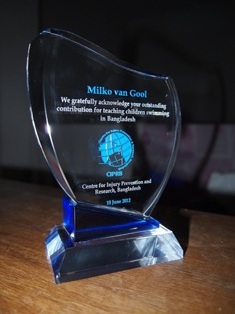
A very nice token of appreciation from CIPRB, in my name, but through me of course to all contributors


5. Closing the chapter, and starting a new one
My posting in Bangladesh is coming to an end. All I can hope for is that enough momentum and visibility have now been created for others to continue and help address the problem of drowning in Bangladesh (remember: 50 children drowning per day!) and to massively upscale support for solutions such as offered by CIPRB. Because 1500 children is a nice number, but Bangladesh' population is more than 150 million....

From August onwards my family and I will be posted for four years in .... Malawi. I hope to be able to report on new swim projects soon.

Thursday, 29 March 2012

In Prothom Alo

It is not every day that I find myself in my host country's newspapers like this ;-). From yesterday's Prothom Alo.

From left to right: Musa Ibrahim, an unknown person, myself, Muniruzzaman, Lipton Sarkar, and coach and organiser Hamid.

Sunday, 18 March 2012

Bangla Channel 2012: 3h46m single crossing, double crossing attempt aborted

Back from Teknaf and the Bangla Channel Swim. Managed a single crossing in 3 hours and 46 minutes. Piloting by my Taratari Shipyard crew (Thibault, Alexandra and Mr. Roy) and their Sampan boat was perfect, the weather sunny and not too much wind. Four swimmers: Lipton Sarker, Everest climber Musa Ibrahim accompanied by cameraman Moniruz Zaman, and I set out at appr. 7:00 am, watched from the Teknaf fishing jetty by local people, including a number of women in burkas. The other three all did 'snorkeling swims', i.e. in snorkeling gear including fins. Looks not very helpful to me, but Lipton has crossed the Channel this way already 6 times.

The first two hours were fine and fast, helped by the outgoing tide. It started to get difficult and more tiring already in the third hour, much earlier than I expected. It didn't get much better in the fourth hour, and it turned out that the water was teeming with 'stingers', invisible little jellyfish that feel like a thousend pinpricks, like rolling your face in nettles!  I was relieved to arrive at the beach on St. Martin's Island, where I was received by Hamid the race organiser, press including two TV-crews (!), and a crowd of onlooking locals. I still wanted to make the attempt for the double so I didn't linger: applied some fresh grease and sunscreen, gave one - not very coherent - reply to a TV crew, and was off again. I don't think my arrival was all that impressive: I was quite tired and came onto the beack stumbling.

The attempt at a double crossing had to be given up: just off St. Martin's Island we got caught in a countercurrent combined with a headwind and rougher sea. For 1.5 hours I felt like a hamster in a treadmill as the island seemed to remain exactly where it was beside me, instead of disappearing behind me. While I could have continued swimming for a few more hours to see if I could get out of the current, or for the current to turn, I realised that after that I would still need another 4-5 hours to get back to the mainland. That seemed a tall order in view of the modest volumes of training I had had in the past couple of months and last week's short but nasty bout of stomach flu, which had sensibly undermined my reserves. So I called it quits five and a half hours into the swim while I still felt reasonably well and lucid. On our way back we almost lost the way on an ever rougher sea and were joking that we would land in Birma and spend time in a prison cell...
Lipton arrived at St. Martin's Island after 5 hours and 10 minutes, and also turned around for the double. But he must have swum into the same current as I and aborted his double crossing attempt shortly after me. Musa and Monir arrived at the island both after more than 8 hours - on our return to the mainland we saw them swim and they looked utterly spent - bravo for finishing!

I can't help but feel a little disappointed: this is the first time I do not (fully) finish a swim I had set my mind on, but I am quite sure it was a sensible thing to do. I spoke to Lipton over the phone and he wants us to try the double again next year. We'll see - insh'Allah.

There were a lot of photo and film journalists active, but I haven't seen a single photo or any footage online so far. Will try to post some as soon as I find them.

Thursday, 15 March 2012

Two days to go

A press conference was held on 13 March where the Bangla Channel Swim was presented to the media, see here. I am happy with the extra visibility for the Centre for Injury Prevention and Research Bangladesh. Lipton Sarker's and my planned attempt to try the first ever double crossing of the Bangla Channel is generating some enthusiasm. Steven Munatones was kind enough to mention the swim and the work of CIPRB on his blog 'The Daily News of Open Water Swimming', see here.

Lipton Sarker, Musa Ibrahim and their coach and co-organiser Hamid have already left Dhaka and are practicing  around St. Martin's Island today. Weather forecasts are looking good.

But unfortunately Tullio Ferri has had to cancel his participation for work-related reasons. And I am not 100% well myself: yesterday I had to go to bed early with a throbbing headache, bad muscle pain and a temperature. I feared dengue fever for a moment, but probably not: with copious paracetamol I am back on my feet again this morning, but feeling weak. Hopefully it will just pass - this is no condition to try and swim >30 kms in...

Tomorrow my friend and colleague Aminul Islam and I will take the 12:50 flight to Cox Bazaar, then take a car to Teknaf, where we will have appr. an hour until sunset to practice with my crew and meet up with the others. I will meet my crew and the boat Sampan (kindly made available by Yves Marre's Tara Tari shipyard) for the first time.

Monday, 5 March 2012

New plan: swimming the Bangla Channel on 16 March 2011

Announcing a new plan: to swim the 'Bangla Channel', a 16 km stretch of water from mainland Bangladesh to St. Martin's Island, Bangladesh' southernmost point. It has been swum before by others. This year for the first time it will be a race, with so far only 4 solo participants.

Will tell you more about it soon, as well as about the CIPRB's Swimsafe project, which will start in April, when the weather and the water get warmer.

Saturday, 27 August 2011

Interview with Netherlands Open Water Web now in English translation

On 19 August I posted the text of the interview that Richard Broer from NOWW did with me. A very generous colleague in Brussels, Rose O'Duffy, volunteered to translate that long text for me so the detailed account of my swim is now also available to non-Dutch speakers. Thanks a lot Rose!

If you visit this site for the first time and are looking for pictures of my swim, you can find them by scrolling down to my posting of 28 July, or by clicking here.

Milko

(Interview has been slightly updated, and I've put in the international bank account number for donations.)

INTERVIEW WITH MILKO VAN GOOL FOLLOWING HIS SUCCESSFUL CHANNEL SWIM

By Richard Broer – Netherlands Open Water Web (NOWW)
Translation: Rose O'Duffy

You’ve been preparing for this swim for a couple of years now. Have you learned any lessons from the experience ?

I’ve learned a lot, not just in terms of swimming and training, but also in a more general context.

The most important lesson of course is that with willpower and determination virtually anything is possible. I know that is a well-worn cliché but I came to realise how true it is.
Three years ago I was so unfit that I could only just about manage to swim 500 metres in a swimming pool, and now I’ve done The Channel and in a pretty good time too. That is an important lesson for me, not only in relation to anything else I might want to do in my life but also where my children are concerned.

I also believe that is was sensible to start preparing gradually although that is not normally like me!  In 2009 I did my first 10 km swim (Vriezenveen), at the beginning of 2010 I did a 20 km  warm water swim (Rottnest Channel Swim,  Australia, 24°), in August 2010 I did my first Stavoren-Medemblik (19°), then in February 2011 I did the Rottnest swim again. After that I left Bangladesh for the Netherlands and spent two months training in cold open water, (the river Meuse (Maas), the IJsselmeer as well as a weekend in Dover Harbour with the Channel swimmers’ group organised by the legendary Freda Streeter) in order to round off my training.

I discovered I have good resistance to cold water.  At the beginning of June in Dover it was a revelation to me that I could deal with 5-6 hour training sessions in 12-13° C water. Mentally that was a boon because since then I haven’t been very concerned about temperatures experienced during a Channel crossing (16°).

Given my limited open water experience it was important for me to have an experienced coach, Marcel van der Togt, as sounding board. Although I was well able to organise my own training, at crucial moments over the past two years he intervened with the right advice about technique, (preventing a shoulder injury), training build-up, the need for variety in training and about training intensity viz. the importance of rest and recovery. Two or three weeks before the Swim he gave me a stern talking-to at a time when I was in danger of overtraining and probably saved me a lot of misery for which I’m truly grateful. Marcel’s training philosophy involves among other things increasingly imitating your goal in your training: hence you swim the whole Channel distance in peaks divided by intervals, first over 4 consecutive days,  then over 3, then 2 and finally in 1. This proved a highly successful method for me, and for him too as it turned out:  Marcel swam the Channel the day before me having started training for it only 7 months previously!

Overtraining is a serious risk, both in mental as well as in physical terms. Round about March this year, in particular following a none too brilliant performance in the Rottnest Channel Swim, I became thoroughly fed-up.  Remote consultation with Marcel produced a solution and after a few weeks of reduced swimming and increased cross training (running, rowing, cycling in the gym) I was back on track again. Since then I no longer train when I don’t feel inspired. If you really want to swim the Channel, that inspiration will return of its own accord.

How did your family react ?

Well, with mixed feelings given the amount of time I spent in training over the last few years but right now they are proud and delighted. For me it was absolutely tremendous that my wife, Asha, travelled on the pilot boat too so that she could witness the result of all that training. Her presence along with that of Marcel was a huge support to me.
My job in Bangladesh (Head of development cooperation at the EU Delegation there) is very demanding. Hence my training could not be at the expense of my job but rather at the expense of time spent at home. So that’s why I’m postponing all further major projects for this year in order to make up for lost time with my family.

You were swimming for a good cause. How did you hit upon that cause and did you collect as much money as you expected ?

In Bangladesh I came in contact with the work of the Centre for Injury Prevention and Research Bangladesh (CIPRB) thanks to previous sponsoring activities by my Masters swimming club in Dhaka. This organisation, founded by Bangladeshis and entirely run by them, aims to reduce the appalling number of drowning fatalities among Bangladeshi children (nearly 50 a day!) by simple means like providing information and swimming lessons to the poorest sections of the population. I wanted to give the CIPRB a share of any publicity which my Channel swim might generate. I had no precise idea of the actual amount that I might succeed in collecting, although I now realise that in order to attract big corporate sponsors you need to invest far more time in lobbying than I could manage. All the same,  thanks to numerous donations from individuals I have already reached a figure of 4500 euros (6500 US dollars). Contributions are still coming in and hopefully will continue.
Donations are of course still welcome at account no. BE44 8601 1176 9745 (= IBAN; BIC = SPAABE22) mentioning ‘MvG Channel Swim’.

How did the actual Swim go ?

Around 06.30 am on 27. July we boarded the boat in Dover Harbour,  Marcel, Asha, Captain Paul Foreman with a crewmember and the observer from the Channel Swimming and Piloting Federation. After all the tense waiting it was almost a relief to be able finally to jump into the water and swim calmly to the shore for the start.

After the start I spent half an hour swimming fairly slowly in order to warm up and get into my rhythm, then I moved into a higher gear. I was given feeds (Maxim Carboloader (97% maltodextrine) or Aptonia Hydro Endurance (with electrolytes) every 20 minutes,  plus half a banana every hour with ibuprofen and paracetamol alternately) and that proved to be the right pattern; I never felt hungry and right to the very end I was able to keep swimming with powerful strokes. The sky was grey, looking threatening at times and the sea was choppier than we’d hoped. As I breathe in only on my lefthand side, I had to swim on the righthand side of the boat where the skipper couldn’t see me as well. At the outset it wasn’t easy either for him or for me to keep alongside but then I started to swim sometimes in front of the boat, sometimes behind it, which meant suffering occasionally from diesel exhaust fumes. Fortunately later on things improved, although due to the wind and waves it was not easy for the skipper to manoeuver the boat at very low speed, while maintaining that speed constant.

My memories of the middle part of the crossing are pretty vague. Not all that much happens; you just swim, concentrate on your stroke and your rhythm, look at what people on the boat are doing, think of your next feed. The water was cold and fairly clear; I could see jellyfish and garfish passing a few metres below me. Only one jellyfish sting. While swimming and feeding I tried to avoid looking at the British or French coasts because that wouldn’t help anyway in judging whether I was making good progress. In any case because of the swell and the waves I could see very little, just tankers passing from time to time a long way off. Marcel and I had agreed that he would not give me any information at feeding times about the distance covered or how much remained because it would be pretty meaningless given the tidal flows in the Channel. We were calculating on a time of more or less 12 hours so that’s how I divided up my time; 3 hours would see me through 25% of the trip, 6 hours 50% etc. As I had already noticed in the past, including during long-distance training sessions, I tend to take a fair while (sometimes as much as 2 hours) before I really get into my stride, and I start to feel better and swim better only when I’ve completed half the distance. The same thing applied this time. So it was a great boost for the morale when I heard that I was on course for a time of 11 hours, by which stage I was already more than halfway.

Having misunderstood the skipper at one stage, (hour after hour in the sea doesn’t exactly make you more alert…. ) I mistakenly thought that I had had my last feed so I put on a turn of speed. However there were two more feeds still to come! So towards the end for a whole hour I swam flat out. Apparently I still had sufficient reserves for that so the misunderstanding ultimately paid off; with a time of 10 hours, 29 minutes and 45 seconds I clocked in as the fourth fastest Channel swimmer out of 24 successful solo crossings so far this year and am ranked 241th in the all-time list (1658 crossings to date), i.e. in the top 15%. Apart from the fact that I got to the other side, I am very proud of my time too.

What was it like setting foot on land ?

It wasn’t all that easy gaining a foothold on land! We landed on the rocks just under Cap Gris Nez and the official observer had already stated that it was sufficient for him if I just touched the rocks. However after all that swimming naturally you want to stand on the rocks and it entailed quite a bit of clambering to get up on them with a few impressive grazes as a result.

Naturally I was absolutely drained after such a colossal swim. Yet I was not in the state of physical exhaustion, confusion even, which I had been half expecting. I was dead-tired yet I felt very calm, not euphoric nor over-emotional, rather “that’s it”! I allowed myself a few minutes to savour the moment, there, alone on the rocks. I tried to find a little stone to keep as a souvenir but there was nothing at all, nothing but massive slippery boulders!

Even getting  back into the water was not easy due to the crashing waves and smooth, slippery rocks. In the photos I seem to be literally scratching my head wondering how I can safely re-enter the water.

There followed a relaxed 200 metre swim back to the boat where hugs and congratulations were in order. No euphoria, just a sense of profound satisfaction. I was wide-awake and alert. Just a few physical problems; almost immediately I climbed aboard the boat I was violently sea-sick and during the three hour return trip to Dover I puked my guts out. Only after a few hours back in the hotel and after a gigantic evening meal with Marcel and Asha, did it finally sink in what I had achieved, when the first congratulatory messages started arriving. Despite my fatigue I didn’t sleep much that night because of all the excitement.

A month has passed already since your Channel swim and you’re back at your desk in Dhaka. Did you have the opportunity to savour your achievement ?

And how, and it hasn’t stopped yet! After all the Channel is an icon, it’s the Mount Everest of open-water swimming and the challenge has been fascinating people for over a century. You are made well aware of that. Of course I appreciated the countless messages of congratulation both in the Netherlands and in Bangladesh. It was a strange experience being the focus of so much attention in the – local – media (TV, radio and press) and it was great to be able to highlight the work being done by the CIPRB.

Got any plans for the future ?

After a week of complete rest and a bit of recovery training in the Netherlands, I am now picking up the thread again and resuming swimming and running at a relaxed pace. I have a few other ideas in the sporting context but for the present, nothing of the same magnitude as the Channel. I definitely intend staying fit and being able to do 10-20 km swims. I’d like to vary my training more with more speed- and cross training. But this year training takes a back seat to family and work.

Have you any tips for anyone else aiming to swim the Channel ?

One single Channel swim does not make me an expert but I’d be happy to let aspiring Channel swimmers share my limited experience (my e-mail address; mvgchannelswim@gmail.com). Here are a few general and strictly personal tips based on my own experience;

-          Start in time to train hard and frequently but watch out for overtraining, do not train when you don’t feel like it or when you’re genuinely too tired. Above all train “smart”, with well-defined peak periods followed by sufficient rest and recovery. Taper off adequately (at least two weeks) before the Swim.
-          Maintain balance in your life, don’t forget your family, friends and social life. Try to plan training peaks where possible before and after (and not during) busy times at work and at home, so that the one does not have to yield to the other. Relax over a beer from time to time. Ensure you get enough sleep.
-          Prepare yourself mentally for the sea temperature in the Channel by doing if possible a few long training swims in much colder water.
-          Vary your training more than I did … don’t just do long training swims, do interval and fast work as well, including cross training (running, rowing, …) for the sake of diversity.
-          Consider taking on a coach with specific experience. You should definitely get in touch with other (aspiring) Channel swimmers, e.g. via the Channel Swimmer's Google chat group.

Thank you very much.
My pleasure!

Monday, 22 August 2011

Donations update

Pleasant surprise! I checked the project bank accounts today, and the total amount donated so far is:

4476,48 euros!

I am extremely pleased with this result. It means that your gifts will now be able to pay for e.g. a fully equipped and installed movable basin for swimming lessons in a city or town, or a sizeable number of bamboo platforms in the rural areas. I will soon sit down with CIPRB to discuss the best ways to spend this money, and keep you informed.

Friday, 19 August 2011

Three weeks after the Channel

(lange NL tekst onderaan)
Since The Swim I have given a few interviews to local (Brabant) and other news media. To compensate for my long silence I will list them below (please click on the hyperlinks). All news coverage was in Dutch, but non-Dutch speakers may enjoy some of the footage of the swim taken by Asha as included in some of the videos. (I haven’t gotten around (yet) to doing a video of the swim for Youtube.)
  • Richard Broer, a reputed Dutch open water swimmer and editor of the website NOWW (Netherlands Open Water Web) interviewed me a few days ago. As it is the most detailed account of my swim, I copy it below in its entirety (with Richard’s permission), or click here for the original article with pictures.
  • On 28 July, returning from Dover and right before entering the Channel Tunnel I was interviewed on live radio by Omroep Brabant, hoarse as a crow after having had my vocal chords pickled for ten and a half hours in Channel water. Omroep Brabant TV also had a news item with video on my swim the day after with some short fragments of me swimming and reaching the French coast. All items can be found here.
  • Local Oss broadcaster D-TV also did an item on my swim, see here for the item with video.
  • Regional broadcaster Brabant10 will do an item on the swim by the end of August (I will add the link later).
  • Last but not least, apart from publishing my monthly columns (unfortunately not available online), the Brabants Dagblad newspaper had its reporter Henk Verhagen blog about my progress on the day of the swim. It carried another article on 29 July.
In the meantime, things have gotten very much back to normal. We’re back in Dhaka, where the monsoon rains are flooding the streets. The children are getting back into their school routine, Asha into running our household, and I into the last year of my work here before we move on to an as yet unknown destination next Summer.
While I enjoy my new status as a certified Channel Swimmer, it is a little awkward suddenly not to have an objective to train towards after having had a major one for a few years.  I hope that I will have the opportunity in the future for a few more (ultra-)long distance endeavours.

Total funds raised so far are approaching 3000 euros, with donations still coming in. Accounts will remain open for a little longer before I transfer the funds to CIPRB.

Milko

------

Here’s the interview with Netherlands Open Water Web (click here for the original article with pictures).

Je hebt aan deze tocht een paar jaar gewerkt. Wat zijn de lessen die je voor jezelf hieruit trekt?
Ik heb er heel veel van geleerd, zowel puur zwem- en trainingstechnisch als in meer algemene zin.
De belangrijkste les is natuurlijk dat met wilskracht en doorzettingsvermogen vrijwel alles mogelijk is. Dat is een nogal versleten cliché, maar ik heb mogen ervaren hoezeer het waar is. Drie jaar geleden was ik zo uit vorm dat ik met moeite 500 meter  in een zwembad zwom, en dan nu Het Kanaal, in een nog vrij vlotte tijd ook. Dit neem ik mee als een belangrijke les, niet alleen voor al het andere dat ik in mijn leven nog eens zou willen doen, maar ook voor mijn kinderen.
Ik geloof ook dat het verstandig geweest is om de voorbereiding geleidelijk aan te pakken, hoewel geleidelijkheid niet echt in mijn aard zit. Ik heb in 2009 mijn eerste 10 km (Vriezenveen) gezwommen, begin 2010 een 20 km in warm water (Rottnest Channel Swim in Australië, 24°C), augustus 2010 mijn eerste Stavoren-Medemblik (19°C), februari 2011 nog een keer Rottnest. Vervolgens ben ik al eind mei vanuit Bangladesh naar Nederland gegaan om twee maanden lang in koud open water (de Maas, het IJsselmeer, en een weekend in de haven van Dover met de Kanaalzwemmersgroep van de legendarische Freda Streeter) de training te kunnen afronden.
Ik heb ontdekt dat ik goed tegen koud water kan. Een simpel feit, maar wel belangrijk natuurlijk. De openbaring was begin juni in Dover, waar ik trainingen van 5 en 6 uur in water van 12-13°C bleek te kunnen verdragen. Moreel was dat een flinke oppepper, want ik heb me sindsdien geen zorgen meer gemaakt over de temperatuur tijdens de Kanaalovertocht (16°C).
Met mijn beperkte openwater-ervaring was het voor mij belangrijk om een ervaren coach, Marcel van der Togt, als klankbord te hebben. Hoewel ik goed in staat was om mijn trainingen alleen af te werken, heeft hij de afgelopen twee jaar op beslissende momenten het juiste advies gegeven over techniek (waarmee ik een schouderblessure heb kunnen voorkomen), trainingsopbouw, het belang van variatie in de training, en over trainingsintensiteit c.q. het belang van rust en herstel. Hij heeft me een week of drie voor mijn overtocht stevig toegesproken toen ik dreigde te overtrainen, en me daarmee waarschijnlijk voor veel onheil behoed, waar ik hem dankbaar voor ben. Zijn trainingsfilosofie bestaat er onder meer uit dat je steeds meer je doel imiteert in je training: zo zwem je in pieken met tussenpozen de afstand van Het Kanaal in 4 opeenvolgende dagen, dan in 3, dan 2, en eventueel 1. Deze aanpak heeft voor mij prima gewerkt, en voor hemzelf trouwens ook: Marcel zwom de dag voor mij eveneens Het Kanaal over, met slechts 7 maanden voorbereiding!
Overtraining is een groot risiso, zowel mentaal als fysiek. Rond maart dit jaar had ik er, ook na een niet al te voorspoedig verlopen Rottnest Channel Swim in februari, even zwaar tabak van. Overleg op afstand met Marcel bracht uitkomst en na een paar weken minder zwemmen en meer crosstraining (rennen, roeien, fietsen in de sportschool) ging het weer. Sindsdien train ik niet meer wanneer ik geen zin heb. Als je echt Het Kanaal over wil, komt die zin vanzelf weer terug.
Hoe was het voor je achterban?
Gemengde gevoelens door de tijdsinvestering die de trainingen de afgelopen jaren vergden, maar op dit moment zijn ze toch trots en blij. Het was voor mij geweldig dat mijn vrouw Asha meeging op de boot, zodat ze het resultaat van al die training heeft kunnen zien. Haar aanwezigheid, naast die van Marcel, was een enorme steun.
Mijn baan in Bangladesh (hoofd ontwikkelingssamenwerking bij de EU Delegatie aldaar) is veeleisend. Trainingen gingen dan ook niet ten koste van mijn werk maar wel vaak van tijd thuis. Daarom wil ik voor dit jaar grote projecten even uitstellen, om tijd met mijn gezin in te halen.
Je zwom voor een goed doel. Hoe ben je bij dat doel gekomen en heb je opgehaald wat je verwachtte?
Ik ben in Bangladesh door een eerdere sponsoractie van mijn Masters zwemclubje in Dhaka in contact gekomen met het werk van het Centre for Injury Prevention and Research Bangladesh (CIPRB). Dit is een geheel door Bangladeshi’s opgezette en gerunde organisatie die zich onder meer beijverd om door voorlichting en zwemlessen met eenvoudige middelen onder de armste bevolking het verschrikkelijke aantal verdrinkingsdoden (bijna 50 per dag!) onder Bangladeshi kinderen terug te dringen. Ik wilde het CIPRB graag laten meeliften op de eventuele publiciteit die ik met mijn overtocht zou kunnen genereren. Over de hoogte van het bedrag dat ik eventueel zou kunnen ophalen had ik geen precies idee, al weet ik nu dat je om grote bedrijfssponsoren te interesseren veel meer tijd in werving moet investeren dan ik heb kunnen doen. Niettemin ben ik met een behoorlijk aantal giften van particulieren al tot een bedrag van bijna 3000 euro gekomen. Er komen nog steeds bijdragen binnen, en ik hoop op meer. Donaties zijn dan ook nog steeds welkom op rekeningnummer 44.92.05.878 t.n.v MvG Channel Swim.
Hoe verliep de oversteek zelf?
We gingen op 27 juli rond half zeven ’s ochtends scheep in de haven van Dover: Marcel, Asha, kapitein Paul Foreman met een bemanningslid en de waarnemer van de Channel Swimming and Piloting Federation. Na de spanning van het wachten was het bijna een opluchting om eindelijk het water in te springen en rustig naar het strand te zwemmen voor de start.
Na de start heb ik het eerste half uur vrij rustig gezwommen om warm te worden en mijn ritme te vinden, daarna ben ik meer bewust tempo gaan maken. Voedingen (Maxim Carboloader (97% maltodextrine), Aptonia Hydro Endurance (met elektrolyten), en ieder uur een halve banaan met afwisselend ibuprofen en paracetamol) vonden om de 20 minuten plaats en dat bleek een adequaat ritme: ik heb geen ‘hongerklop’ gehad en heb tot op het einde kracht achter mijn slagen kunnen zetten. De lucht was grijs en soms dreigend, en de zee toch woeliger dan we hadden gehoopt. Doordat ik alleen links ademhaal moest ik voortdurend rechts van de boot zwemmen, waar de schipper me minder goed kon zien. Aanvankelijk was het ook niet gemakkelijk voor hem en mijzelf om precies gelijk op te gaan, maar zwom ik dan weer voor de boot uit, dan weer achter de boot aan, waarbij ik ook een paar keer last had van dieselwalmen van de uitlaat. Later ging dat gelukkig beter, al zorgden de wind en de golven ervoor dat het voor de schipper een hele klus bleef om de zeer langzaam varende boot te manoeuvreren en een constante snelheid te geven.
Mijn herinnering aan het middenstuk van de oversteek is nogal vaag. Er gebeurt niet zo heel veel: je zwemt, let op je slag en je ritme, kijkt naar wat de mensen op het dek doen, denkt aan je volgende voeding. Het water was koud en vrij helder: ik zag kwallen en gepen op een paar meter onder me door komen. Slechts één kwallenbeet. Tijdens het zwemmen en de voedingen probeerde ik niet naar de Britse of Franse kust te kijken, omdat je daaraan toch niet kunt zien of je goed vooruitgaat. Door de deining en de golven zag ik sowieso erg weinig, alleen een paar keer op grote afstand passerende tankers. Marcel en ik hadden afgesproken dat hij me bij de voedingen geen informatie zou geven over de afgelegde of de nog af te leggen afstand, omdat dat met de stromingen in Het Kanaal toch niet veel zegt. We gingen uit van een tijd van ongeveer 12 uur en zo deelde ik de tijd in: na drie uur zat ik op 25%, na zes uur op 50% van de tocht, enzovoorts. Zoals ik al vaker heb gemerkt, ook bij lange trainingen, doe ik er lang (soms wel een paar uur) over om helemaal lekker op gang te komen, en begin ik me beter te voelen en beter te zwemmen wanneer ik over de helft ben. Dat was ook nu het geval. Daarbij had ik een morele opsteker toen ik hoorde dat er een tijd van rond elf uur in zat, waardoor ik ineens een groter percentage van de tocht al achter me had.
Doordat ik de schipper op een gegeven moment verkeerd begreep (je wordt er geestelijk niet helderder op na al die uren…) dacht ik te vroeg dat ik mijn laatste voeding had gehad en begon dus fors te versnellen. Er volgden echter nog twee voedingen! Op die manier heb ik op het eind dus nog een uur lang volle bak gezwommen. Blijkbaar had ik daar de reserves nog voor, dus het misverstand is alleen maar gunstig geweest: met 10 uur, 29 minuten en 45 seconden is mijn overtocht de op twee na snelste van de 24 geslaagde solo-overtochten die er dit jaar tot nu toe hebben plaatsgevonden, en staat ze 240e in de ranglijst aller tijden (1636 overtochten tot op heden), dus bij de snelste 15%. Behalve het feit dat ik de overkant heb gehaald, ben ik op die tijd ook wel trots.
 Hoe was het om voet aan land te zetten?
Het was nog niet zo gemakkelijk om aan land te komen! We landden bij de rotsen iets onder Cap Gris Nez en de officiële waarnemer had gezegd dat het voor hem voldoende was als ik alleen de rotsen zou aantikken. Maar na dat hele eind zwemmen wil je natuurlijk op de rotsen staan, en het was nog een hele klauterpartij om eruit te komen, met een paar fikse schaafwonden tot gevolg.
Natuurlijk was ik goed ‘uitgepierd’ na zo’n enorm eind zwemmen. Toch was ik niet in de staat van lichamelijk uitputting en zelfs ontreddering die ik half en half had verwacht. Behalve doodmoe voelde ik me vooral erg rustig, niet euforisch of erg emotioneel, meer een ‘ziezo’-gevoel. Ik heb een paar minuten de tijd genomen om van het moment te genieten, in mijn eentje daar op die rotsen. Ik zocht een steentje om als souvenir mee te nemen, maar er lag helemaal niets, alleen maar grote glibberige rotsblokken!
Ook terug het water ingaan viel niet mee door de stevige golfslag en de spekgladde rotsen. Op de foto’s zie je me letterlijk op mijn hoofd krabben terwijl ik me afvraag hoe ik weer veilig in het water kom.
Vervolgens een paar honderd meter rustig terugzwemmen naar de boot, waar felicitaties en omhelzingen volgden. Geen euforie, slechts diepe tevredenheid. Ik was helder en alert. Wel enig fysiek ongemak: vrijwel meteen toen ik op de boot stond werd ik hevig zeeziek, en ik heb op de drie uur durende terugtocht naar Dover mijn ziel en zaligheid eruit gekotst. Het was pas na een paar uur, terug in het hotel na een enorme avondmaaltijd met Marcel en Asha, dat het echt tot me doordrong wat ik had klaargespeeld, toen de eerste gelukwensen binnenkwamen. Ondanks de vermoeidheid heb ik die nacht maar weinig geslapen door de opwinding.
De Kanaalovertocht ligt inmiddels alweer bijna drie weken achter je, en je bent al weer aan het werk in Dhaka. Heb je kunnen genieten van je prestatie?
Nou en of, en dat gaat nog steeds door. Het Kanaal is toch een ikoon, de Mount Everest van het openwaterzwemmen, en spreekt al meer dan honderd jaar tot de verbeelding van mensen. Dat was en is goed te merken. Uiteraard heb ik genoten van alle gelukwensen zowel in Nederland als in Bangladesh. Het was ook een aparte ervaring om zoveel aandacht in de –lokale- media (TV, radio en krant) te krijgen, en het was mooi dat ik het werk van het CIPRB voor het voetlicht kon brengen.
Nog plannen voor de toekomst?
Na een week volledige rust en wat hersteltrainingen in Nederland ben ik nu de draad aan het oppakken en weer rustig aan het zwemmen en lopen. Ik heb nog wel andere ideeën op sportief gebied, maar voorlopig even niets van dezelfde orde van grootte als Het Kanaal. Ik wil in ieder geval fit blijven en 10-20 km tochten kunnen blijven zwemmen. Ik wil mijn training ook weer wat gevarieerder maken met snelheids- en crosstraining. Maar training zal dit jaar ondergeschikt blijven aan familieleven en werk.
Is er nog iets wat je wilt meegeven aan zwemmers die ook een Kanaaloversteek ambiëren?
Eén enkele Kanaaloversteek maakt me nog geen expert, maar ik zou het leuk vinden om andere aspirant Kanaalzwemmers in mijn beperkte ervaring te laten delen (mijn e-mail: mvgchannelswim@gmail.com). Een paar algemene en puur persoonlijke adviezen gebaseerd op eigen ervaring:
  • Begin op tijd en train veel en hard, maar kijk uit voor overtraining, en train niet wanneer je geen zin hebt of echt te moe bent. Train vooral slim, met welbepaalde piekperioden en voldoende rust en herstel. Doe een lange (minstens twee weken) taper voor de oversteek.
  • Houd balans in je leven, en vergeet familie, vrienden en gezelligheid niet. Plan trainingspieken zoveel mogelijk rondom (en niet: tijdens) drukte in je werk en privéleven, zodat het een niet voor het ander hoeft te wijken. Drink gerust een biertje. Zorg voor genoeg slaap.
  • Bereid je mentaal voor op de temperatuur van het Kanaal door zo mogelijk een paar keer lang te trainen in nog veel kouder water.
  • Train gevarieerder dan ik heb gedaan... Niet alleen lange trainingen, maar ook interval en snelheidswerk, en crosstraining (lopen, roeien, …) voor de afwisseling.
  • Overweeg een coach met specifieke ervaring in de arm te nemen. Zoek in ieder geval contact met andere (aspirant-)Kanaalzwemmers, bijvoorbeeld via de Google chat group
Dank je wel.
Graag gedaan!

Milko’s blog:                http://mvgchannelswim.blogspot.com
E-mail:                         mvgchannelswim@gmail.com
Donaties:                     rekeningnummer 44.92.05.878 ten name van MvG Channel Swim


Thursday, 28 July 2011

Some pictures

We are on our way out of the hotel, so no time to write, but here are some pictures. Click on the phots to enlarge.
In the shipping lanes, in the middle of the swim, still many hours away from France.

Proof that made it: having clambered over some big and slippery rocks, I am the tiny figure celebrating in the middle of the picture.

Having swum back to th boat I am getting out of the water, face swollen after more than 10 hours in the water

Let's not forget what this swim was about. You can still contribute: see the buttons on top of the page! :-)

I couldn't have done it without my crew. From left to right: Marcel van der Togt (my coach and also successful Channel swimmer, me, my wife Asha, captain Paul Foreman, and deck hand Ray. The CS&PF observer is not in the picture, as he was taking it.

GELUKT!! - DID IT!!

(English below)

Beste vrienden,

Het is nu officieel: ik ben Kanaalzwemmer! Mijn tijd vandaag was 10 uur, 29 minuten en 45 seconden, sneller dan ik durfde te hopen. Watertemperatur was 16-17 graden Celsius, zee ruwer dan ik verwachtte, maar wel gunstige rugwind.

Heel erg bedankt voor alle steunbetuigingen tijdens de overtocht: ik kreeg ze steeds doorgegeven via Asha tijdens de voedingen en dat hielp enorm tijdens de moeilijke momenten, die er zeker waren!

Morgen hoop ik meer details en foto's te kunnen geven, ik moet nu mijn bed in!

Milko


Dear friends,

It is now official: I am a Channel Swimmer. I swam the Channel today in 10 hours, 29 minutes, 45 seconds, faster than I could have hoped for.  Water temp was 16-17 degrees Celsius, sea a bit rougher than expected, but a favourable wind in the back. Let me add that I have now a much better understanding and even more respect for the achievements of the legendary Bangladeshi swimmer Brojen Das, who crossed the Channel 6 times!

Thanks so much for your messages of support: Asha transmitted them all to me during feeds, and they very much helped me through some of the difficult moments.

Will try to give more details and pictures tomorrow, I really need some sleep now.

Milko

Tuesday, 26 July 2011

Alea iacta est: Wednesday morning 6.45 am GMT

captain's final verdict came through at 7 pm: I'll be swimming tomorrow morning from 6.45 a.m GMT onwards (7.45 a.m. NL time; 11.45 a.m Bangladesh time). You should be able to track my boat's movements for most of the day by clicking here (make sure you select the map 'Folkestone' in the rolldown menu on the left - the name 'Pace Arrow should appear in the map).

Great news: Just 2 hours ago Marcel made it to the French coast in 14 hours, which is exactly what he had predicted. He is now on his way to Dover Harbour. His wife Lilian and his 2 children will be there to give him his well-deserved hero's welcome; I might if I can't sleep. An awesome achievement, especially taking into account his relatively short preparation time (7 months), though building of course on tons of experience. But it proves that his training method works.

I write this in a Dover hotel room with a view on the Channel, which is flat as a mirror right now. No wind at all! I have spent my day being quite nervous, trying to nap while Asha was roaming the shopping centres of Dover with Lilian, stuffing myself with more pasta than I though humanly possible (carboloading - yuck), watching the weather forecasts, preparing my feeds, and writing this message. It will be almost a relief to actually be in the water and swim

I'll try and catch some sleep now. My next message will tell you if my attempt was successful or not. Thanks for the messages of encouragement I have been receiving so far, they are a real support!

in Dover

We just arrived in Dover after a smooth car trip. As usual I slept very little last night, so will go for a nap now to catch up. Paul Foreman will call me around 7 pm.

Conditions look good: little wind. Marcel is doing fine: he was halfway the French shipping lane an hour ago.

Monday, 25 July 2011

Wednesday ever more likely

Spoke to Paul Foreman again this morning: more than on the weather it now depends on the speed of the swimmer preceding me on Tuesday whether I will swim on Wednesday or Thursday. This being the Channel, conditions can change any moment of course. Nevertheless, Asha and I are driving to Dover tomorrow morning.

I did a 1-hour work-out today at a good clip, with 3 or 4 short sprints. Right shoulder still a bit stiff and sore, but it got better after a half hour of swimming.  Virus not completely gone, but I think I am good enough to go.

Sunday, 24 July 2011

Wednesday?

Spoke again with the captain this morning: I will not swim earlier than Wednesday, if the 2 preceding swimmers swim on Monday and Tuesday. Winds are more forceful than predicted, so no swims today and tomorrow. Paul Foreman explained to me that solos only start at Beaufort 2-3 maximum, relays up to Beaufort 4, sometimes 5 (depending on the direction, I presume)

There is still time as the current neap tide is until 29 July. If I don't swim before Friday we'll have to wait until 7 August, when a new neap tide starts.

The good news is that this buys me extra time to get rid of my - fortunately fairly mild - virus infection and to give my ailing right shoulder some more rest. I am already feeling better than a few days ago. I haven't swum for two days. Will do a very easy 1.5 hour work-out tomorrow morning, just to keep the juices flowing.

Marcel van der Togt is now in Dover, waiting for his swim to come up, presumambly on Monday morning.

Friday, 22 July 2011

Swimming in 3 or 4 days?

Just off the phone with my captain Paul Foreman. I have 2 swimmers before me, if the weather stays as it is and if both swimmers accept to swim, I might be swimming on Monday or Tuesday! I'll start packing my bags today.

I have been feeling slightly under the weather over the past four days, probably some virus: sore throat, cold shivers and cold sweats. There's not much that I can do but sleep, drink tea and take extra vitamins. All I am worried about is this thing turning into a full-blown flu.

Wednesday, 20 July 2011

Standby

In spite of recent foul weather, conditions have improved in the Channel and no less than 8 swimmers/teams started their attempt last night. Forecasts (see here) are such that more attempts will probably follow in the days ahead while this neap tide lasts (21-29 July).

I just spoke by phone to my captain Paul Foreman (boat: Pace Arrow), just as he was delivering a swimmer to Cap Gris Nez! We discussed my wish to swim in the current neap tide rather than 7-12 August, with all the risks of getting delayed (my flight back to Dhaka is booked for 11 August). He told me that there might be a possibility for me to swim this weekend or shortly thereafter, once and if all his other swimmers for this tide have started, that is, or if one of them wishes to postpone.

So, this is it - I am in standby mode as of today! Nerves into high gear, adrenalin pumping. Hopefully only for a few days, but possibly for weeks to come, depending on weather, other swimmers, etc etc.

Mentally I am quite ready now: while I am very respectful of the distance and the water temperature (appr. 16 degrees), I do not fear them. Physically I am well prepared, even if I could probably have improved on my training and diet on several points. My shoulders and the rest of my body have for the most part recovered from my 31-kms swim ten days ago, but my right shoulder is still not 100%, a little more stiff and sore than the left one. But the tendinitis seems to have abated (though not completely disappeared) thanks to rest and shorter work-outs. Lower back and neck (my usual weak spots) OK.

So I'll continue my short (1-2 hours) and rather easy work-outs, with just a few sprints to keep me on my toes.  It's all about maintenance and recovery now. It is hard not to train more than I do: I feel like a dog pulling the leash, jumpy and nervous, which is said to be typical for tapering periods.

By the way: Marcel van der Togt is also in standby mode for his own swim, as he is in 2nd postion for the current neap tide with captain Mike Oram (ship: Gallivant). I think he can be expected to swim in the next couple of days.